
A Chinese spacecraft lands on the moon's far side to collect rocks in growing space rivalry with US
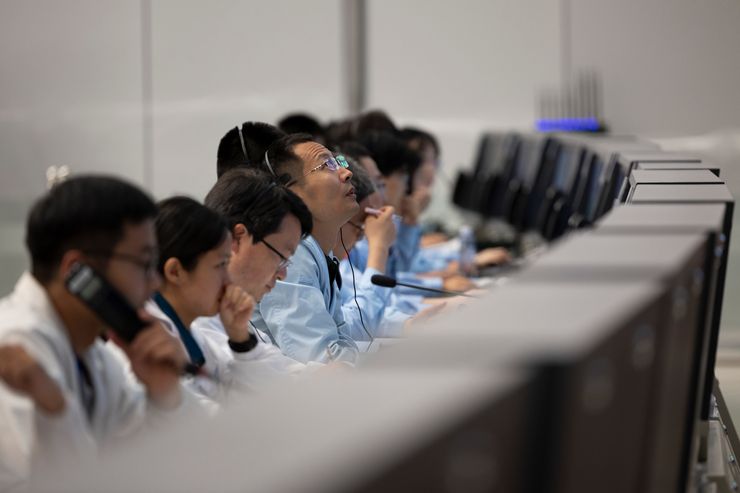
A Chinese spacecraft has landed on the moon’s far side to collect rocks, in a growing space rivalry with U.S. The official Xinhua News Agency says the landing module touched down Sunday morning Beijing time
BEIJING (AP) — A
Chinese spacecraft
landed on the far side of the moon Sunday to collect soil and rock samples that could provide insights into differences between the less-explored region and the better-known near side.The landing module touched down at 6:23 a.m. Beijing time in a huge crater known as the South Pole-Aitken Basin, the China National Space Administration said.
The mission is the sixth in the Chang’e moon exploration program, which is named after a Chinese moon goddess. It is the second designed to bring back samples, following the
Chang’e 5
, which did so from the near side in 2020.The moon program is part of a growing rivalry with the U.S. — still the leader in space exploration — and others, including
Japan
and India. China has put its own space station in orbit and regularlysends crews
there.The emerging global power aims
to put a person on the moon
before 2030, which would make it the second nation after the United States to do so. America is planning to land astronauts on the moon again — for the first time in more than 50 years — though NASApushed the target date back
to 2026 earlier this year.U.S. efforts to use private-sector rockets to launch spacecraft have been repeatedly delayed. Last-minute computer trouble
nixed the planned launch
of Boeing's first astronaut flight Saturday.Earlier Saturday, a Japanese billionaire
called off his plan
to orbit the moon because of uncertainty over the development ofa mega rocket
by SpaceX. NASA is planning to use the rocket to send its astronauts to the moon.In China’s current mission, the lander is to use a mechanical arm and a drill to gather up to 2 kilograms (4.4 pounds) of surface and underground material over about two days.
An ascender atop the lander will then take the samples in a metal vacuum container back to another module that is orbiting the moon. The container will be transferred to a re-entry capsule that is due to return to Earth in the deserts of China’s Inner Mongolia region about June 25.
Missions to the moon’s far side are more difficult because it doesn’t face the Earth, requiring a relay satellite to maintain communications. The terrain is also more rugged, with fewer flat areas to land.
The South Pole-Aitken Basin, an impact crater created more than 4 billion years ago, is 13 kilometers (8 miles) deep and has a diameter of 2,500 kilometers (1,500 miles), according to a report by China's Xinhua News Agency.
It is the oldest and largest of such craters on the moon, so may provide the earliest information about it, Xinhua said, adding that the huge impact may have ejected materials from deep below the surface.